
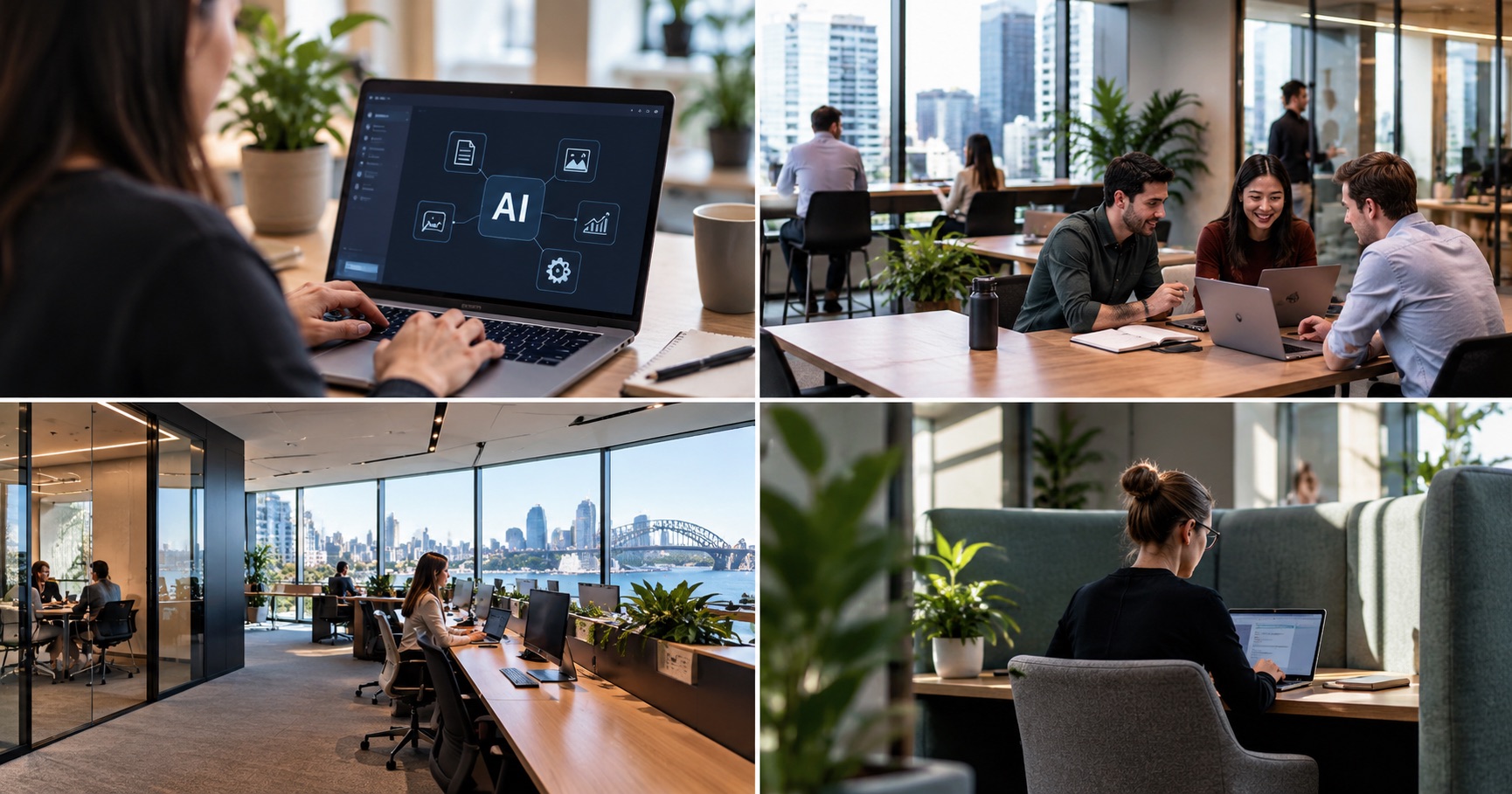
AI use is changing not only how employees work, but what they expect from the office when they return to it. New findings from design firm Hassell suggest staff are using AI across a widening set of locations, prompting employers and landlords to reconsider office design around focused work, mentoring and higher-value collaboration.
Hassell’s latest global survey of 2500 office workers across Australia, Hong Kong, Singapore, the United Kingdom and the United States found home remains the leading place for AI-assisted work at 59 per cent. The company office and a desk were both nominated by 53 per cent of respondents, while workers also reported using AI before or after work, with friends or family, in bed and even in a bathroom.
For business owners, the finding points to a practical shift: AI is making work more portable, but that does not make the office irrelevant. Instead, the workplace is being asked to perform a more specific role.
The survey partly challenges earlier expectations that AI would reduce office demand and turn workplaces mainly into places for meetings and information sharing. Daniel Davis, Hassell’s head of research and a co-author of its 2026 Workplace Futures Survey, said collaboration still matters, but the office is again being judged on its ability to support individual productivity.
The worker priorities identified in the survey underline that shift. Respondents wanted more space for learning and mentoring at 33 per cent, more space to focus at 30 per cent and more privacy at 29 per cent. Training space was nominated by 25 per cent, while more quiet and space to take a break from the computer each recorded 23 per cent.
James Harvey, a software engineer at office-building software company Equiem, shows how that change can work in practice. Since Anthropic’s Claude Opus 4.6 became good enough to help him produce code at the standard he needed, he has used AI to run multiple coding processes at once. He said the office remained useful because waiting time while AI worked could become time spent talking with colleagues.
The implications also extend to commercial property value. IFM Investors head of property Amanda Steele told The Australian Financial Review Property Summit that San Francisco showed AI could increase demand for better-quality office stock, as AI companies and businesses performing higher-level tasks occupy prime workplaces. She said lower-grade assets linked to more routine functions were more exposed.
Cushman & Wakefield director of strategic foresight and intelligence Richard Pickering also told the summit that AI should be viewed as a broad reset for real estate, not merely a software change. He said offices supporting high-value activity would increasingly separate themselves from those built around more commoditised work.
A&O Shearman offers one example of how AI is changing office planning. The law firm began using Harvey, a legal industry large language model, in 2022. Angela Keogh, its head of finance and business services, said AI had altered how lawyers worked and how the firm thought about its physical workplace.
Last year, A&O Shearman moved into 2500 square metres across two floors at 33 Alfred Street in Sydney’s Circular Quay. The fitout includes a mix of offices, high-quality open-plan settings, meeting rooms and quiet rooms, supporting activities such as mentoring junior staff, brainstorming and meeting clients.
The broader message for Australian businesses is that AI adoption is not only a technology decision. It is also changing how teams use space, what employees value in the office and how workplaces need to support focused, collaborative and client-facing work.
SOURCE ATTRIBUTION:
Based on reporting by Michael Bleby for The Australian Financial Review, published Monday 14 September 2026.